NAD+ and the metabolic work of muscle
A muscle can respond differently to insulin while its owner’s body composition stays the same. For NAD+, I start with that selective human result.
The NMN trial population
In the 2021 trial in prediabetic, postmenopausal women, 10 weeks of oral NMN at 250 mg/day improved muscle insulin sensitivity, measured with a hyperinsulinemic-euglycemic clamp. The technique assesses the body’s response under controlled insulin and glucose conditions. Body composition and HbA1c did not change.
My enthusiasm stops at the measures that actually changed. The result gives a particular metabolic response somewhere to stand; claims about wholesale rejuvenation would have to bring their own evidence. I can attach some confidence to that result because the participants and outcome are specified. Broad claims built on that narrow foundation leave me unconvinced.
NMN is nicotinamide mononucleotide, a precursor from which cells can make NAD+. The trial therefore concerns an oral precursor. The ingredient cannot quietly become intravenous NAD+ when the finding travels beyond the paper.
NAD+, NADH and cellular energy
Nicotinamide adenine dinucleotide has an everyday chemical job beneath all the excitement. NAD+ accepts electrons and becomes NADH; NADH then helps deliver them through energy metabolism. The review of NAD+ metabolism during aging also describes another demand on the molecule: enzymes including sirtuins, PARPs and CD38 consume it in processes connected with gene regulation, DNA repair and inflammation.
The replenishment idea has a mechanistic foundation. In mice lacking CD38, NAD+ levels and SIRT3 activity were preserved with age, alongside better mitochondrial function. The strength of that mouse experiment is its test of a particular cause. The human situation requires its own measurements: the later clinical review describes only a limited number of human studies consistently demonstrating age-related NAD+ decline.
The phrase “youth molecule” seems overexcited to me. A tissue’s NAD+ supply, the work drawing on it and the consequences of changing that supply offer much more to think about.
Blood NAD+ after oral precursors
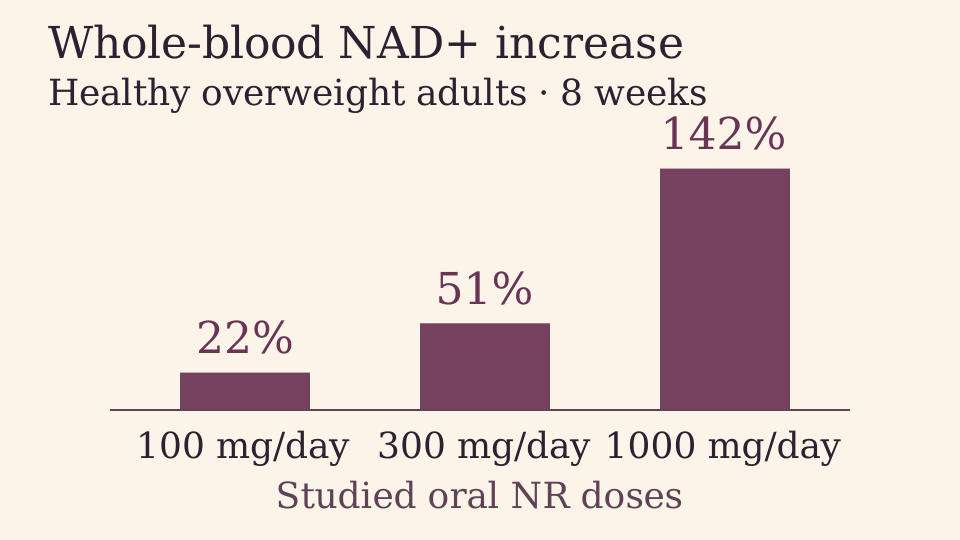
The NR trial in healthy overweight adults gave 100, 300 or 1000 mg/day for 8 weeks. Whole-blood NAD+ rose by 22%, 51% and 142%, respectively. The study reported no flushing and no significant differences in adverse events from placebo; NR did not elevate LDL cholesterol or disrupt one-carbon metabolism. These are the study’s regimens and findings, with their short observation period attached.
A separate multicenter NMN trial in middle-aged adults tested 300, 600 or 900 mg/day for 60 days. Blood NAD+ increased at days 30 and 60 versus placebo (p≤0.001). The current account also reports improved walking distance and quality-of-life scores in the 600 mg/day group, with no safety concerns reported at any studied dose.
The blood response is convincing enough to deserve its own picture. Its clinical meaning is a further question. The 2025 human-evidence review found limited efficacy across clinical outcomes and sparse information on tissue-specific NAD+ dynamics. I would judge muscle preservation by sustained muscle outcomes, however impressive a blood result looks.
Heart muscle and HMGCS2
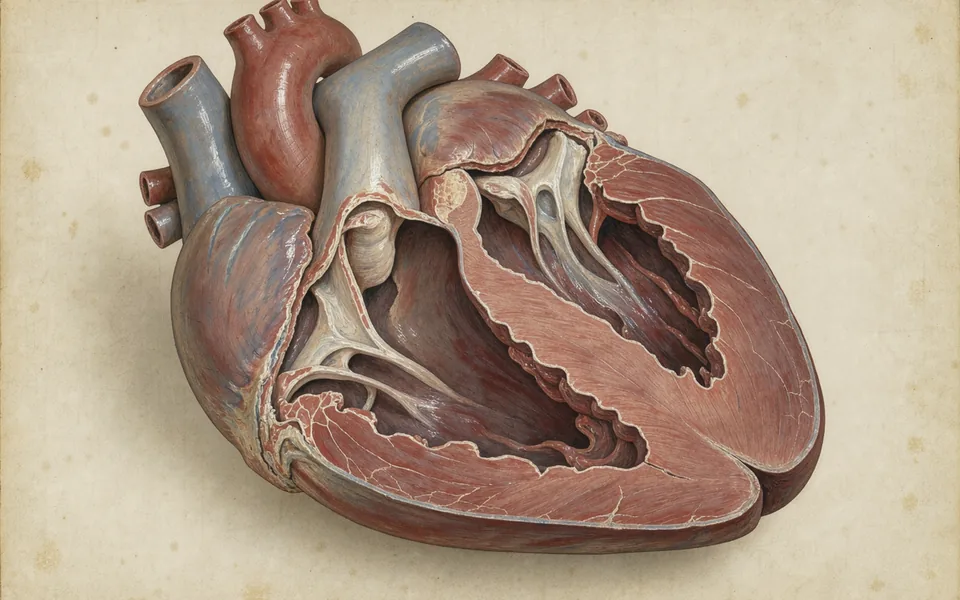
A 2025 study of NAD+ and heart failure with preserved ejection fraction adds another muscle to the discussion. The work used human myocardium, meaning heart tissue, and a mouse model of HFpEF. It connected NAD+ repletion with restoration of the activity of HMGCS2, an enzyme involved in ketone production, and with increased fatty-acid oxidation.
The cardiac rescue was in the mouse model and depended on HMGCS2: it failed when HMGCS2 was knocked down in cardiomyocytes, the heart’s muscle cells. I admire that dependence because it narrows the explanation. The human tissue component supports biological relevance; it supplies no clinical trial demonstrating improved heart-failure outcomes in treated patients.
NAD+ infusion cautions
NAD+ precursors have been sold as dietary supplements, while FDA has contested NMN’s supplement status because it was investigated as a drug. Compounded injectable NAD+ has no FDA approval. FDA recalled a compounded NAD+ injection for elevated bacterial endotoxin (Class I).
The infusion claims run ahead of the controlled evidence described in this literature. Reported cautions include chest or abdominal discomfort, flushing and nausea when infusions run too quickly, along with rapid clearance of infused NAD+ from plasma. Oral-precursor trials cannot establish the safety or benefit of an injectable preparation.
There is also a theoretical concern about supplying NAD+ to existing cancers, given its role in proliferating cells and its context-dependent biology. It remains a question, rather than a demonstrated cancer outcome of the trials above. Supplement purity and actual content can vary, and short trials leave long-term safety unresolved.
For the comparison with a mitochondrial peptide, the MOTS-c vs NAD+ page returns to muscle outcomes and the very different human records.